
All glory to God.
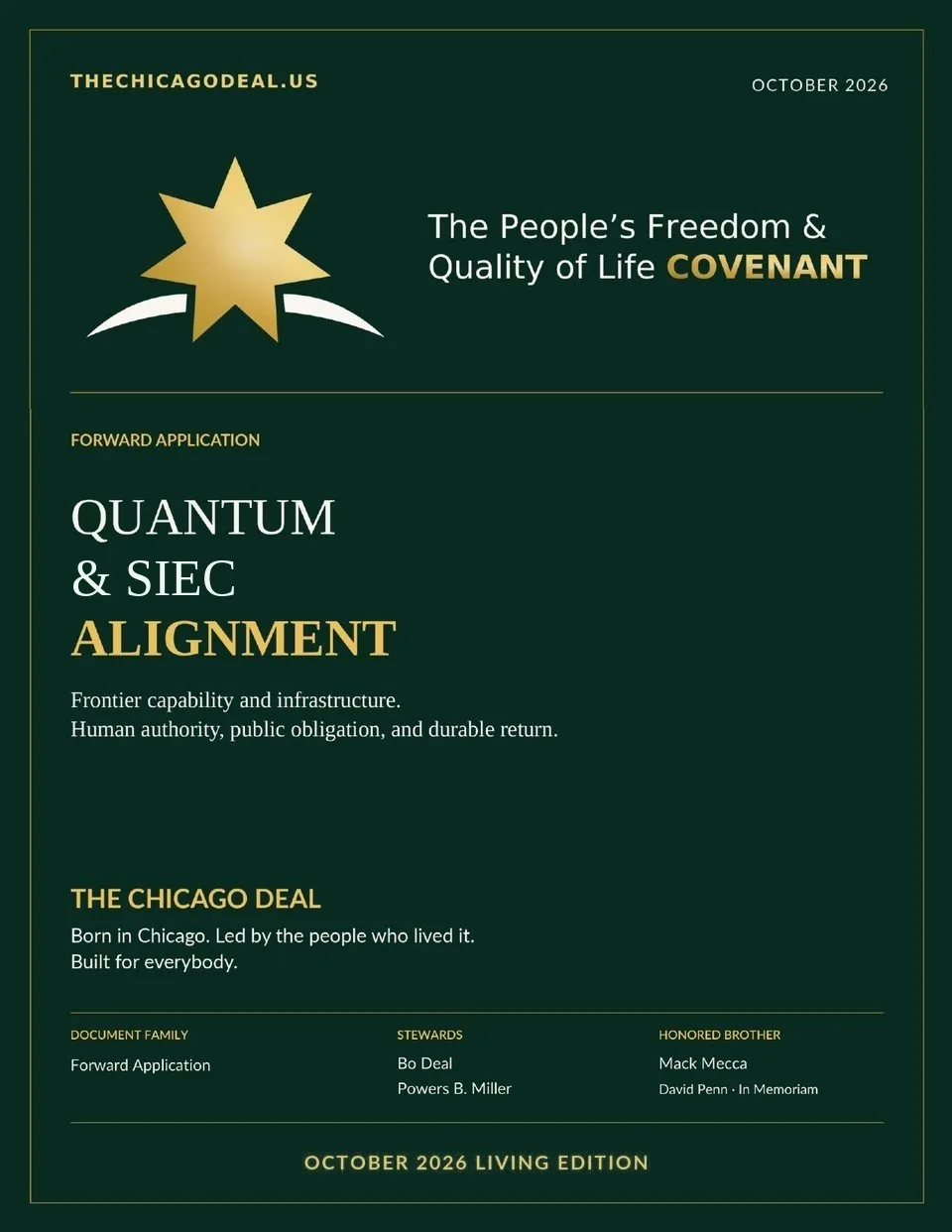
THE CHICAGO DEAL
Quantum & SIEC Alignment
A proactive covenant offer from the streets of Chicago — born from the violence, built for the living, and aligned openly with the federal administration. It binds the public-supported technology future to a people’s return.
Permanently nonpartisan. The people and the administration at the head of the table; the State and City invited to it. Organized around safety, water, work, ownership, and quality of life.
October 2026 Living Edition · Forward Application
Edition date: October 31, 2026
Authors The Streets of Chicago
Stewards Bo Deal · Powers B. Miller
Honored Brother Mack Mecca · David Penn · In Memoriam
Companion to Lead Pipe 2050, the Chicago Unity Memorial, and the Skilled Builders Covenant.
The Deal on One Page
Most readers of an alignment memo never find the deal inside it. So here it is first, in deal terms, before the argument that supports it.
The moment. In June 2026, three things were true at once. Washington organized the next frontier of quantum technology and signed two executive orders to speed it. Chicago was burying its dead again after another violent weekend, and the President’s renewed offer of federal help was again refused. And beneath both stories, the water still runs to hundreds of thousands of homes through known toxic lead pipes. One government. One pattern of misalignment. The future it wants moves fast; the lives it owes are told to wait.
The offer. The people of Chicago can create the alignment the politicians refuse to create. If the federal administration wants lawful national reach, and if Illinois wants the federal edge for the quantum bet it has already funded, then The Chicago Deal is the bridge — on one condition: public-supported technology must produce a public return, and the same seriousness shown for the future must be shown for the lives already owed.
The alignment. The people seek to align with the federal administration openly and on the record — not as Republicans, not to flip a city, but because the administration is willing to act when the city and state will not. The covenant is and remains permanently nonpartisan; its charter forbids giving money to any political party, ever.
The consideration. The people bring organized reach and a set of finished policy lanes. In exchange, every party agrees that the advantage created with public land, water, power, attention, and money is bound to portable benefits, worker-to-owner pathways, community equity, clean water, public safety, and public proof.
The table has a head — the people and the administration, aligned. The State and the City are invited to it; the seats are real and open, but the alignment does not wait on them.
| Party | Their part | What they receive |
| The people / the covenant (at the head) | Bring organized reach, finished policy lanes, and a lawful civic ground game — and hold every party publicly accountable to the terms. | Leverage over the future they are funding, converted into portable benefits, ownership pathways, community equity, and a public-proof standard the people keep and control. |
| Federal administration (at the head) | Convene the lawful table and act where the city and state will not: attach public-return conditions to the quantum-related federal edges it controls (designation, DOE / NSF / DOL / Commerce hooks), recognize Skilled Builders, and direct intervention to the proof lanes — the Memorial and toxic-lead-line replacement. | Lawful national reach rooted in the people closest to the struggle; a cross-partisan, quality-of-life issue on the public record; a Chicago-origin proof story that travels to every state. |
| State of Illinois (invited) | Invited to join and align: tie its existing IQMP / Quantum Shore public support to enforceable public return rather than private upside alone. | If it joins: stronger federal positioning for the quantum bet it has already funded, and a share of a public win instead of another subsidy headline. |
| City of Chicago (invited) | Invited to join and align: connect quantum readiness (land, power, water, permitting) to toxic-lead-line replacement, the Memorial, and a local workforce pipeline. | If it joins: a technology-and-quality-of-life alignment that visibly includes safety, work, ownership, and clean water. |
The close. We are asking for one lawful table, with the people and the administration at its head and the State and City welcome to join. This is the domestic version of the deal posture the administration has built its identity around: a public conflict is blocking a public win — and it is costing lives — and the people are offering the way through.
Part One — The Moment and the Misalignment
1. Three clocks, one government
The country saw the whole picture in one window. Washington moved the future forward with quantum orders. Chicago was reduced to a violence headline again, and the city and state again refused the federal help the President again offered. And under the streets of both stories, hundreds of thousands of service lines still carry water into homes through known toxic lead.
These are not three subjects. They are one indictment running on three clocks. The fast clock is the future the government wants — land, power, water, permits, and federal attention organized at speed for a quantum campus on the old South Works site. The slow clocks are the lives the government owes — a toxic-lead replacement timeline measured in decades, and a violence emergency the city will not take help to end. Same government. Same political pettiness. Same cost, paid in lives.
The covenant refuses the trap of choosing a side in the argument. The fight is real — a city and state in long political conflict with the administration, including over federal immigration enforcement and sanctuary policy, are allowing that conflict to block what the people are owed. The covenant does not enter that fight to take a partisan side. It enters to ask the only adult question: who will align for the people of Chicago — on the killing, on the water, and on the future — at the same time?
2. This began with the names
Before there was a quantum lane or a lead-pipe lane, there were the names. This covenant did not begin in a policy shop or a technology briefing. It began in grief — in the plain question of whether Black lives in Chicago really matter to the people who govern them, asked in the middle of weekends spent counting the shot and the dead. Across roughly five decades, tens of thousands of Chicagoans have been lost to violence — by the Memorial’s count, more than forty thousand. Each one is a name a family still carries.
That is why the Chicago Unity Memorial is not a line item in this deal. It is the moral floor beneath all of it. The Memorial’s one-time seventy-seven-million-dollar ask — structured at one million per Chicago community area — is the first thing the covenant asks the country to honor, because it is the thing that came first: the dead, and the promise not to let their names dissolve into a crime statistic.
And the grief is not abstract. A few miles from the towers of Streeterville, where residents can expect to live to about ninety, the South and West Side neighborhoods where the toxic lead pipes run see lives end around sixty — a thirty-year gap that NYU researchers in 2019 found to be the widest in the nation. The map of the shortest lives is also the map of the oldest pipes and the longest waits. The violence, the water, and the disinvestment are one wound.
The covenant carries that wound differently now. The first instinct was the lawsuit, the accusation, the demand for indictment — and those instincts were set down on purpose. Revenge is God’s, not the people’s. The people’s work is to expose the truth and to advocate the solution. So the covenant comes not to charge anyone, but to build. The Memorial is where the building begins.
3. This is a deal, not an investigation
Earlier instincts drifted toward investigation — publish this, audit that, build another scoreboard, file the claim. Those tools can matter later. They are not the first move. The first move is alignment.
The Deal does not have to prove every hidden corner of the money stack before it can act. The public already sees the pattern: public money carries the risk, private capital is positioned for the upside, communities receive promises, and political leaders fight while opportunity moves and people die. That pattern is enough to justify a deal posture. The first question is not whether the technology is impressive. The first question is whether the people will own any of the value, work any of the work, control any of the tools, and live longer because of it. The answer is not another authority managing another bucket of money on a promise of good intentions. The answer is covenant architecture: community trust, community equity agreements, worker-to-owner pathways, person-controlled data, portable benefits, and a transparent public record of who supports the deal and who declines.
4. Illinois is already in the quantum bet
Illinois is not deciding whether to enter the quantum economy. It is already in. The Illinois Quantum and Microelectronics Park is planned as a roughly 128-acre public-private campus on the former U.S. Steel South Works site, inside the larger Quantum Shore development, with PsiQuantum as the anchor tenant and the DARPA–Illinois Quantum Proving Ground among the partners.
Independent reporting by the Illinois Answers Project has put the public money dedicated to the site at roughly $960 million so far, with the State of Illinois as the largest single funder, and has questioned whether the guaranteed-job commitments are proportional to the subsidy scale, alongside open questions about the site’s water use and a peak power demand estimated in the hundreds of megawatts. These figures should always travel attributed to their public source. The point is not to stop the campus. The point is to prevent the usual sequence — public subsidy first, private positioning second, community promise third, enforceable people’s benefit last or never — and to use the moment to demand alignment that helps the state win federally while making the public return real.
5. The federal edge is real
On June 22, 2026 the administration signed two quantum orders — Executive Order 14411, “Ushering in the Next Frontier of Quantum Innovation” (an updated National Quantum Strategy, a science-enabling quantum computer effort, DOE specifications, supply-chain and manufacturing planning, NSF user facilities, and a workforce push built on registered apprenticeships, credentials, and National Quantum Workforce Development Institutes), and Executive Order 14409, “Securing the Nation Against Advanced Cryptographic Attacks,” accelerating the federal transition to post-quantum cryptography, with migration deadlines, NIST guidance, and federal procurement rules.
So the federal edge is real, and it does not have to arrive as one obvious check. It can arrive as priority status, designation, procurement, grants, national-lab coordination, workforce recognition, supply-chain placement, cyber procurement rules, and credibility. A state aligned with the administration can chase those edges directly; a state fighting the administration can still win pieces, but speed, trust, and discretionary partnership can move elsewhere. That is not a conspiracy. That is how power works — and it is precisely the leverage the people can convert into a public-return covenant.
Part Two — What the People Bring
The people do not arrive empty-handed, and they do not arrive making promises they cannot show. The strength of this offer is not the size of a claimed crowd. It is the set of finished, concrete assets already on the table.
6. The covenant above the lane
Quantum and AI are not the deal. They are one lane inside it. The deal is the People’s Freedom and Quality of Life Covenant, carried publicly as The Chicago Deal. Its governing promise is larger than any single federal action, technology announcement, mayoral race, or election cycle: benefits that follow the person, ownership that follows the work, and community wealth that follows the value created.
That is why every aligned lane feeds the larger rails — the People’s Benefits and Ownership Trust, portable benefits, worker-to-owner ladders, and community equity. And it is why the covenant binds itself by charter: it is permanently nonpartisan, it will never give money to a political party, and it will not become a machine, a union, or a special interest wearing new language. Its power comes from the people, from day one. That is the only place its power will ever come from.
This lane answers to the Seven, the standard of the People’s Freedom and Quality of Life Covenant: Health, Stability, Peace and Safety, Family, Opportunity, Ownership, and Truth and Respect.
Health: technology that adds years, starting with the water and the names.
Stability: portable benefits that follow the person into the new economy.
Peace and Safety: tools pointed at safety, not surveillance.
Family: income that funds a child’s future.
Opportunity: credentials and work in the build-out.
Ownership: a public return on public-supported technology.
Truth and Respect: every yes and every no on the public record.
The lane is judged by those outcomes, not by investment announced.
7. Aligned with the administration, owned by no party
Let there be no ambiguity about the alignment. The people seek to align with the federal administration — openly, deliberately, and on the record. Not because the people are Republicans. Not because the goal is to flip Chicago red. The reason is simpler: the administration is willing to act, and the people will align with whoever will help them save lives, clean the water, and build the future with them. The covenant aligns where truth and quality of life align, and it would carry the same deal to any administration willing to meet it.
8. Reach, and a lawful civic ground game
The most valuable asset in the Deal is not a grant or a consultant. It is reach — the trust held by the people closest to the struggle: workers, fathers, mothers, creators, returning citizens, small businesses, contractors, churches, barbershops, and families. It is the vote no consultant can find and the builders no workforce program has reached.
This reach is not theoretical, and it is not a party brand. It runs through real networks already organized in the trenches — the Non-Gang Organizations built by men who walked away from the violence, and the Unity Movement and others like it: street infrastructure that can activate quickly, in Chicago and across the country. That capacity becomes a lawful civic ground game — voter education, candidate accountability, community organizing, worker activation, and quality-of-life mobilization built around one question: who supports the deal? It is not a machine and not a ballot scheme. Its instrument is transparency: a public, on-the-record yes or no. Supporters can be told to the people; so can those who decline. That is leverage, and it is lawful.
9. Culture is the distribution
The culture still owns the culture — but it has been extracted from. Artists, musicians, athletes, creators, barbers, promoters, and street voices have carried the message of America for generations while other people owned the lanes, the contracts, the platforms, the data, and the upside. The Deal does not ask the culture to become a campaign prop. It builds the ownership rails so the culture can speak as itself, earn from itself, and tell the truth around the gatekeepers. Once truth moves through trusted cultural channels, the old media bottleneck loses control of the first impression. This is not celebrity politics; it is covenant distribution.
10. Humanizing the technology
The public has been handed two scripts about AI and quantum: fear it, or worship it. Neither asks the people’s question — can we use these tools to improve daily life? The Deal humanizes advanced technology. It asks for tools the people can command, under their own covenant rules, to solve their own problems: understand rights, find work, schedule crews, train builders, navigate benefits, protect creators, translate forms, support teachers, and organize community ownership. Technology that can listen, organize, explain, train, and match must be pointed at human dignity — not only at surveillance, speculation, or investor upside. The people do not ask to be managed by AI. They ask to command tools that help them build.
11. Skilled Builders: the workforce bridge — and the answer to the fight
Advanced technology is physical before it is digital. It requires buildings, power, cooling, fiber, security, water systems, substations, and long-term operations — a building lane of electricians, refrigeration workers, plumbers, water-system crews, remediation workers, trades, fiber and grid workers, security, and logistics. The Skilled Builders Covenant is the bridge because it understands what the official system misses: America does not lack people who can build; it lacks a lawful system to reach the builders it already has, respect them, equip them, pay them seriously, and move them toward ownership. The quantum order’s own apprenticeship and credential language gives this lane a direct federal hook.
And there is a quiet answer here to the very fight consuming the city. Much of the political conflict turns on undocumented workers already living and laboring in Chicago. The Skilled Builders lane is the lawful, dignified resolution: bring that work into the daylight — verified, credentialed, taxed, paid serious wages, on a real path — instead of leaving it in a shadow economy that suppresses wages for everyone. The covenant does not litigate the fight. It dissolves it, by building the lane that makes the argument unnecessary. The fight itself, meanwhile, keeps producing contested flashpoints — in the same June news cycle, the federal government tied an immigration-enforcement action to a 2024 Chicago shooting, an arrest DHS attributed to the city’s sanctuary posture and county officials dispute — which is exactly why a lane that resolves the question serves the people better than another round of the argument.
Part Three — The Bargain
12. Setting the table
The table is not an ambush of the governor and the mayor, and it is not about them as people. The invitation to them is genuine: sit down and build this with the people. But the record answers for them. Violence has run for five decades and taken more than forty thousand lives. The toxic lead has been known since 1986, with a replacement timeline the city has let drift toward 2076 — ninety years after the danger was named. Chicago has had roughly ninety-five years of single-party municipal leadership; the state carries a long legislative supermajority; and the public-corruption record is documented — a former Speaker of the Illinois House was convicted in 2025 of bribery, conspiracy, and wire fraud, sentenced to seven and a half years, and had that conviction upheld on appeal in 2026. None of this is an accusation the covenant has to prove. It is the structure’s own record.
So the critique is of the machine, not the people who happen to occupy it right now. And because that machine will not move itself, the people turn to the one mechanism that can move it: federal intervention, sought by a people openly aligned with the administration. That is why the head of the table is the administration and the people, together — not because the people serve the President, but because he is aligned with what the people already want, and federal action is the only path left after a century of local refusal.
Federal intervention is concrete, not abstract. It looks like seventy-seven million dollars directed straight to the Memorial — to the families and the names — instead of chopped into fragments across the anti-violence nonprofit apparatus that consumed billions while the violence continued. It looks like a direct accountable federal lane that replaces toxic lead lines on a real timeline rather than a generational one. The State and the City are welcome at this table; the seats are real and open, and they can share the win. But the alignment does not wait on them.
13. Federal edges the Deal can help unlock
The federal government has multiple lawful edges that can strengthen Illinois’ quantum position without turning the Deal into a simple funding request. The ask is to align them where lawful, and to let the public see that citizen-led alignment unlocked the win.
- National Quantum Strategy priority — Illinois recognized as a node where a public-return covenant is attached to workforce, ownership, portable benefits, and community trust.
- DOE and national-lab coordination — Argonne, Fermilab, DOE specifications, testing, and facilities aligned with Chicago proof lanes where lawful.
- NSF user-facility and equipment-access grants — shared quantum facilities tied to real training access, not only elite institutional access.
- Department of Labor apprenticeships and credentials — quantum-adjacent infrastructure trades, Skilled Builders, and public-health infrastructure in one workforce lane.
- Commerce supply-chain and manufacturing support — domestic supplier opportunities connected to workers, small firms, and contractor ownership.
- Post-quantum cybersecurity procurement — training, compliance, and small-business support so the people are not locked out of the new security economy.
- Critical-infrastructure modernization — power, cooling, data, and water readiness connected to quality-of-life proof, not separated from it.
- Portable-benefits and worker-ownership integration — advanced-technology work that feeds the People’s Benefits and Ownership Trust, not another disconnected jobs announcement.
14. The two proof lanes: the slow clock made physical
The covenant is tested where it can be counted. Two lanes do that, and together they are the slow clock made visible — the water, and the names.
Lead Pipe 2050 is the water. Chicago carries the largest known municipal burden of toxic lead service lines in the country — roughly 412,000 of them — against a city timeline that stretches across generations. No one has to prove a single death to a single pipe; that is not the claim. The claim is simpler and harder to answer: the lines are lead, the lead is toxic, it is known, it is in the water of hundreds of thousands of homes, and the plan is to wait. In the highest-life-expectancy neighborhoods, ninety is about the ceiling a person can hope for; in the neighborhoods where the toxic lead runs, lives end in the sixties. The covenant does not argue the cause. It names the outrage — immoral, documented, hidden in plain sight by the noise of the larger fight — and it answers with a direct accountable federal lane: a defended $17,500 unit target (roughly half the reported Chicago cost), serious wages and portable benefits for the workers, crews that become businesses, and every dollar shown against every completed line.
The Memorial is the names. It is the anti-violence lane and the moral floor — federal anti-violence support routed to a family-led, transparent vehicle that honors the dead and funds prevention, instead of disappearing into the same apparatus that consumed billions while the violence continued. It carries a principle the covenant insists on everywhere: credit and pay follow the people who do the dangerous work. The frontline messengers who cool conflicts the police cannot reach should be named and funded — not used to tell a progress story and then left unpaid and unnamed.
Put beside the quantum clock, the contrast makes the whole argument without a raised voice: government can move at speed for the future it wants. The people are asking it to move with the same seriousness for the lives it already owes — the water in the pipe, and the names on the wall.
15. The on-record question
This issue can become a state, local, and federal test — not a loyalty oath, but a transparency standard. Candidates do not have to become quantum experts. They have to answer one quality-of-life question on the record:
“Do you support a citizen-led alignment table that helps Illinois compete federally while binding public-supported technology to public return — quantum, AI, Skilled Builders, Lead Pipe 2050, the Memorial, portable benefits, and community equity — yes or no?”
The question cuts across party captivity. A Republican can support it for federal priorities, skilled trades, public safety, anti-fraud, domestic manufacturing, and lawful civic work. A Democrat can support it for public return, worker dignity, community benefit, water, and health. An independent can support it because it is not party property — it is quality of life. Anyone who declines simply has to explain why political conflict matters more than the lives it is costing.
16. What the people keep
The people keep independence. That is non-negotiable. The Deal is not absorbed into a party, agency, consultant shop, nonprofit machine, or centralized data structure. The people remain the author, the ground game, the moral claimant, and the beneficiary. The covenant builds its own rails: community trust, community equity agreements, benefits that follow the person, ownership that follows the work, and technology controlled through consent and covenant rather than surveillance and dependency. Government can recognize, align, authorize, support, and help prove. It does not own the covenant. The people do. That is how the Deal avoids becoming the very thing it was created to correct.
Closing Charge — Align With the People
The country is entering an age where advanced technology may define power, wealth, security, medicine, work, and information itself. If that age is built only by capital, government, contractors, and platforms, the people will again be asked to live under a future they did not design — and to keep burying their dead while they wait for it.
Chicago is bringing a deal. Not a riot. Not a lawsuit. Not a think-tank paper. A deal — with parties, an offer, a consideration, and a signature line. It began with the names, and it carries them still. The deal says the streets can become civic leadership, the builder can become an owner, the worker can become a contractor, the citizen can become a shareholder in the value created, the water can run clean, and the future economy can be pointed at the lives it was supposed to serve.
This is the work the people’s own representatives were elected to do. Across an entire Congress, it did not get done. The people did it anyway — and they are bringing it to the table finished.
The politicians can keep fighting, or they can come to the table. The people are already there.
All glory to God. Let’s keep building. Amen.
Verification — Public Source Anchors
Confirmed against public reporting on June 23, 2026. The executive orders, the Madigan appeal, and the Lead Pipe 2050 figures were rechecked on October 31, 2026.
- Two quantum executive orders signed June 22, 2026 — Executive Order 14411 (“Ushering in the Next Frontier of Quantum Innovation”) and Executive Order 14409 (“Securing the Nation Against Advanced Cryptographic Attacks”). White House presidential-actions pages; corroborated by Nextgov/FCW, The Quantum Insider, ABC, TechTimes.
- Chicago weekend violence and the Trump–Pritzker dynamic, June 2026: roughly six to seven killed and ~38–39 injured over the Juneteenth weekend; the President’s Sunday (June 21) renewed call for federal help; the Governor’s prior public refusals. Multiple outlets. (Quantum order and violence are the same news cycle, not the same calendar day.)
- Violence toll: cumulative Chicago homicides over roughly five decades run into the tens of thousands (CPD/UCR annual data — peaks of 970 in 1974, 948 in 1992, 805 in 2021). The “more than forty thousand” figure is the Memorial’s own count and is stated as such; the conservative public-data floor (“tens of thousands”) leads the sentence.
- Life-expectancy gap: NYU School of Medicine / City Health Dashboard analysis (2019, CDC data 2010–15) — Streeterville ~90, Englewood ~60, a ~30-year gap, found to be the nation’s widest.
- Illinois public-corruption record: former House Speaker Michael Madigan convicted February 2025 (bribery, conspiracy, wire fraud), sentenced to 7.5 years and a $2.5M fine in June 2025, reported to federal prison October 2025, conviction upheld by the 7th Circuit on April 27, 2026. The jury deadlocked on the racketeering count.
- IQMP / Quantum Shore — ~128-acre campus on the former U.S. Steel South Works site; PsiQuantum anchor; DARPA–Illinois Quantum Proving Ground. Public-money, per-job, water, and power figures are Illinois Answers Project reporting.
- Lead Pipe 2050 figures (~412,000 toxic lead service lines; $17,500 defended unit target vs. a reported $31,000–$35,000 a line, with the city’s 2026 average about $31,000; multi-decade city timeline) are carried from the completed Lead Pipe 2050 lane.
- Enforcement context for Section 11: on June 22, 2026 DHS announced an ICE arrest tied to a December 2024 Chicago mass shooting, attributing the earlier release to sanctuary policy. The individual is accused, not convicted, and the Cook County State’s Attorney disputes DHS’s characterization. The document refers only to the general fact of an ongoing, contested enforcement conflict.
Edition Record
October 2026 Living Edition · October 31, 2026. The first public edition. It carries forward the Final edition of June 23, 2026, with these changes:
— Title: Quantum & AI Alignment is now Quantum & SIEC Alignment, matching the Human SIEC Charter.
— Two passages from the June draft were set aside and are not part of this edition; the numbered sections after Section 11 move up by one.
— Section 6: the Seven added, so this lane answers to the same standard as the parent Covenant.
— The first-page offer and table, and the on-record question (now Section 15), brought up to date.
— Section 14 and Verification: the Lead Pipe 2050 cost comparison updated to the city’s 2026 figures.
— Verification: the executive orders and the Madigan appeal rechecked; working notes removed.
— The set-aside passages and the internal close-out notes are kept in the private record.
— Edition and credits aligned with the leading documents.
One current Living Edition governs at a time. History remains visible; authority remains clear.